





Understanding the Renaissance
Full-day workshopLevel: Ages 11-18
Times: 9.30am to 12pm and 1.30pm to 4pm
Price: €200
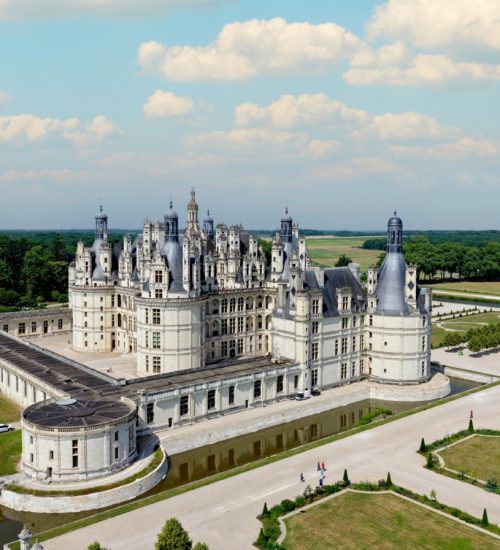
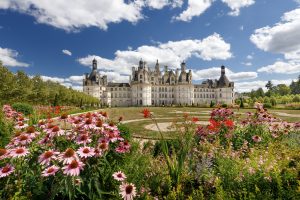
From medieval heritage to Italian influence, students explore the château to investigate 16th century architectural styles, then make use of the knowledge they have gained by designing a palace for François I. The workshop’s approach helps them understand Chambord in the historical and artistic context of the Renaissance.

Objectives:
Understanding the great changes that came about in the art of building (and, by extension, in art in general) at the dawn of the 16th century, under the influence of the Italian Renaissance and through the impetus of the kings of France. Understanding the origins of the Italian Renaissance and its links with the heritage of Antiquity. Discovering that Chambord’s architecture binds notions of functionality, social hierarchy and royal symbolism inextricably together in a single edifice.
Programme:
Sequence 1 (teamwork): Ornamental vocabulary
With the help of an illustrated lexicon, students familiarise themselves with ornamental vocabulary, then go around the château and identify different varieties of sculpted decor, which they have to separate into two families according to whether they belong to medieval or to Renaissance vocabulary. In this way, the young researchers come to understand that François I’s château borrows from both traditions.
Sequence 2 (individual work): Drafting and understanding a plan
Through careful observation, students fill in an outline of the château, adding interior rooms, doors, windows, partitions, passageways and stairs. Comparison of the completed individual plans leads to deliberation on the idea of modularity, and so to the “theory of the beautiful” in the Renaissance.
Sequence 3 (whole group): The theory of the beautiful in the Renaissance
Analysis of Chambord’s plan reveals that the château’s design does a great deal more than simply meet functional criteria, but is very much a result of guiding aesthetic preoccupations. Inspired by the Ancient World’s concept of a perfect universe governed by mathematical laws, Renaissance artists restored the formal preoccupations of Ancient Greece and Rome to favour (symmetry, harmony of proportions, the Golden Number, superposition of classical orders, the Fibonacci sequence, and so on).
Sequence 4 (in classroom teams): Royal Pursuit
Teams of students come up against each other in a quiz inspired by TV game shows, with questions bearing on the Renaissance period (society, great discoveries, artists, ideas, etc.).
Sequence 5 (individual work): Surveying the facade
By making a meticulous survey of the château’s façade, students can revise their ornamental vocabulary and analyse the aesthetic principles that underlie its design. By exercising critical vision, they then compare their results with their knowledge of the château’s interior layout.
Sequence 6 (individual work): A project for François I
Around 1519, when Chambord was being designed, François I commissioned “a number of designs before undertaking anything”. Like Leonardo da Vinci, "Architect to the King”, the students will use the experience they have gathered to design the plan of a château for the king, trying to make their project as historically realistic as possible.
Booking: reservations@epchambord.fr