










Restoration work and archaeology
Restoration work
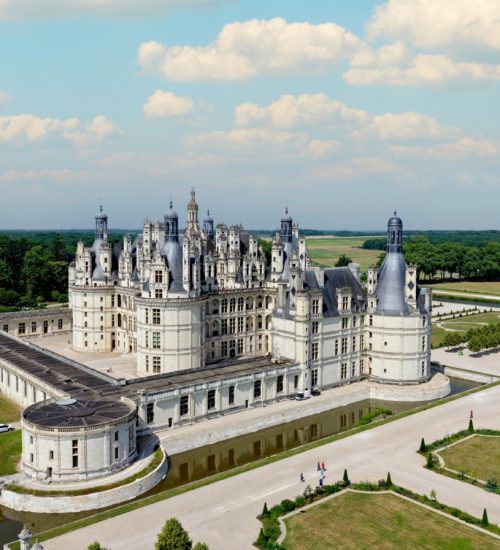
Restoration work is carried out at the Château of Chambord on a yearly basis, under the supervision of Monuments Historiques’ Chief Architect.Far from being of recent origin, documented instances of such work date at least as far back as the 17th century, when, for example, it was a matter of remedying damage caused by rainwater draining on to the terraces and leaking into the sculpted vaults on the second floor –a problem that had first been encountered in 1566! It was only in 2005, however, that work on waterproofing the terraces and protecting the vaults was undertaken, to be finally completed in 2009. Successive stages of restoration work are carried out every year, with alternation of restoration sites enabling visitors to enjoy the best possible conditions as far as the monument’s appearance and accessibility are concerned.
Between 1999 and 2004, new reception and sales areas were fitted out, enabling restoration work to be carried out on the château’s lower entrance wing. During the 1990s, the keep cornices supporting the terrace balustrade required renovation, as did the summit lantern’s flying buttresses.
Further back, urgent rescue work was carried out between 1945 and 1960 (above all during the immediate post-war period) with a view to preventing certain parts of the château from falling into ruin and to enabling it to receive the public at large under the best possible conditions. The chapel vault, which was open to the air, and the absence of roofing on a section of the keep, the result of a fire, were taken care of as rapidly as possible, followed by renovation of floors, woodwork and upper storeys among other things.
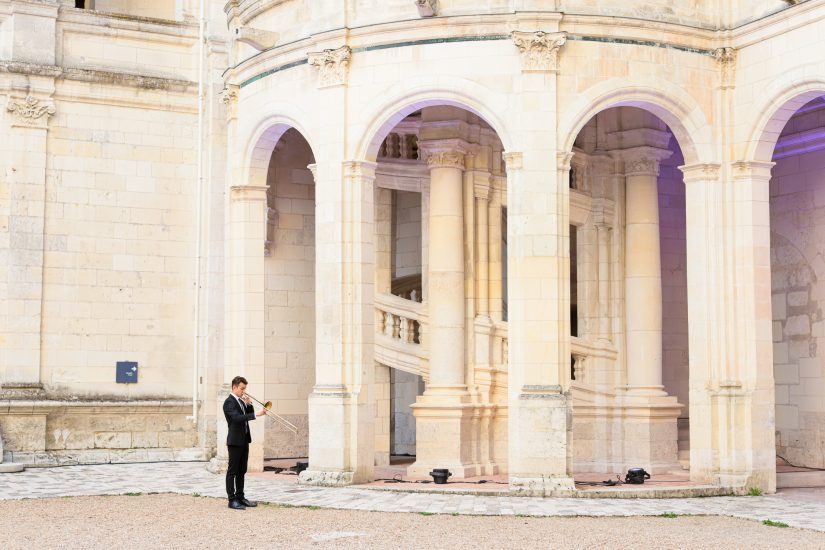
Currently, restoration of the great double spiral staircase is underway, scheduled for completion in 2011 and financed for the first time by the sponsorship of Lefèvre, which has been responsible for restoration work at Chambord since 1947.
The archaeological programme
Because of the absence of archives, many of which were lost during the 18th century while being transferred from the Blois Court of Finances to the one in Paris, little is known with regard to Chambord’s actual construction. This being so, the building stands as a monumental archive to itself, although, of course, one should take all necessary precautions in interpreting it.
Discovery of the keep’s latrine ditches in 1994, and the close examination that followed, opened up a new field for interpretation of the earliest construction work that began in 1519, the year in which the site was opened under François I. An archaeological programme got underway in 1997, with the support of the Chambord Friends Society – its goal being to shed light on the mystery surrounding an initial part of the plan that was finally rejected by the king in favour of another. Apart from this, the numerous fragments of pottery that have been unearthed are still being patiently pieced back together again – testimony to the table arts of bygone days and pointers to what life was like in 18th-century royal kitchens. Alongside all this, preventive digs are carried out by INRAP archaeologists prior to any restoration operation affecting the monument at ground level. Such was the case before commencement of spadework on the lower entrance wing and of drainage and paving operations in the château’s courtyard in 2006 and 2007. A part of the keep’s bricked up base was removed in order to verify the hypothesis that foundations on piles existed. Instead, the remains of a carefully levelled medieval tower were unearthed, acting as a partial support for today’s château and leaving the foundations on piles hypothesis yet to be proved. Digs in the north latrine ditches are scheduled for the summer of 2008.